The best villains don’t think they’re villains, and this one has receipts. The card gives you an antagonist who believes the hero is the real danger, and who can prove more of it than the hero would like. If you are hunting for righteous villain ideas, start here: read the card, watch it come to life, then pick a direction.
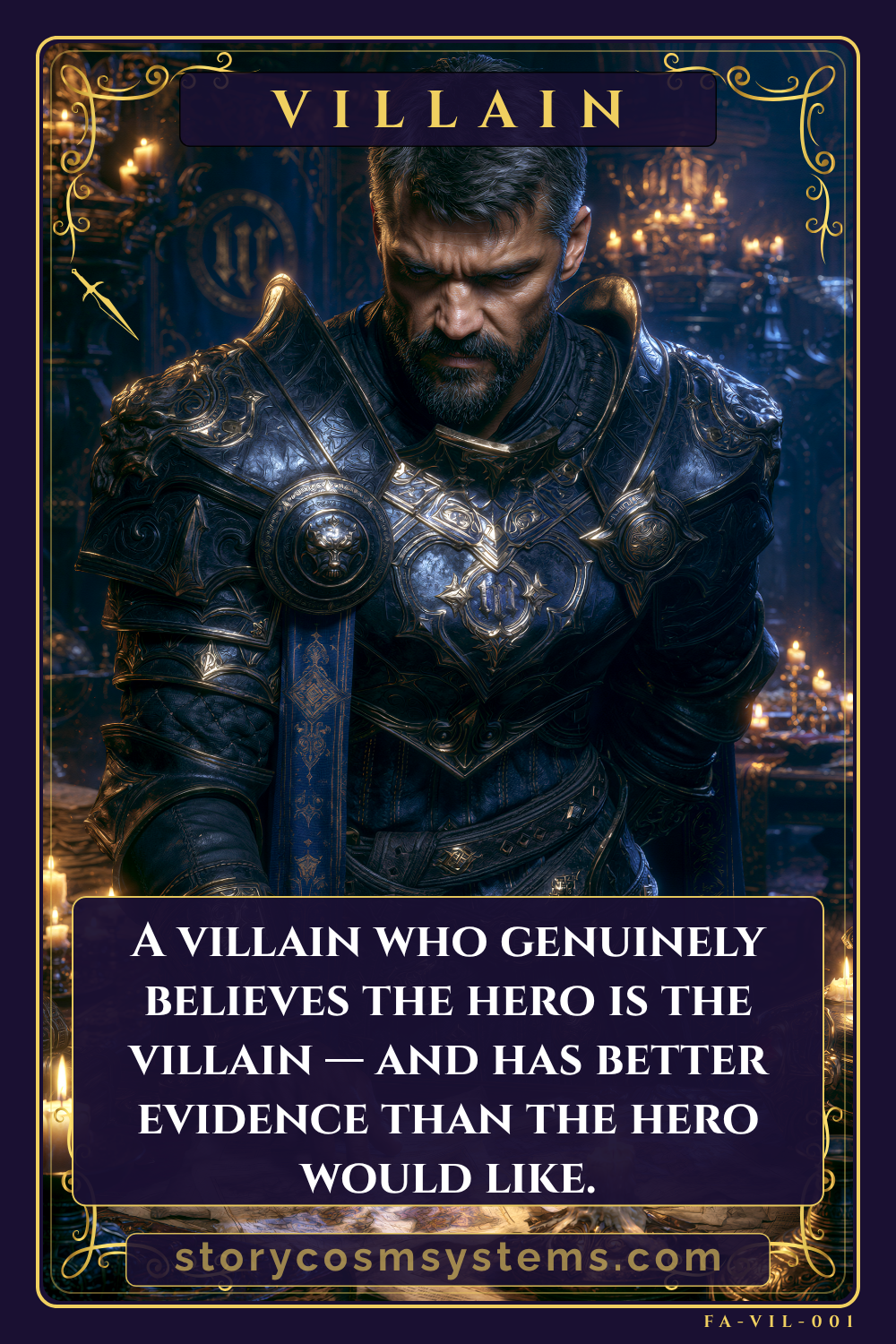
Weak villains twirl mustaches. Strong villains have reasons. But the villains readers never forget have something worse than reasons: they have receipts. This week’s card gives you an antagonist who isn’t lying, isn’t deluded, and isn’t backing down.
A villain who genuinely believes the hero is the villain, and has better evidence than the hero would like.
How to Use a Villain Card
A villain card defines your antagonist’s engine: the belief that makes them move. Build your villain from this card first, then design a hero specifically shaped to be vulnerable to them. The phrase doing the heavy lifting here is “better evidence than the hero would like.” That means your hero has genuinely done something: cut a corner, buried a cost, told themselves a flattering story. Decide what that something is before you write page one. The plot then writes itself: every confrontation forces the hero to defend a version of events the reader slowly stops believing.
3 Ways This Story Could Go
1. The File on the Detective (Thriller)
A celebrated detective (twenty years, a wall of commendations) starts receiving pieces of a dossier. Not threats. Documentation. The informant who died after the detective burned his cover for a headline arrest. The confession squeezed from a suspect who recanted in a cell nobody checked. The compiler calls himself a private citizen finishing the department’s unfinished internal review, and every page is verifiable. When the detective tries to hunt him down, he discovers the man has already shared the file with a journalist, and has lived a quieter, cleaner life than the detective ever has. The climax isn’t a shootout. It’s a deposition, and the hero’s own memory is the unreliable witness.
2. The Dark General’s Ledgers (Fantasy)
The realm’s chosen hero has liberated seven provinces from the armored tyrant in the north. The tyrant’s general, the grim man in black plate, has kept ledgers of every liberation: the granaries the hero’s army torched to deny the enemy, the refugee columns that starved that winter, the “freed” cities now paying triple tithes to the hero’s noble patrons. The north, meanwhile, fed those refugees. When the general finally meets the hero across a parley table, he doesn’t draw a sword. He slides the ledgers across. The war’s final battle is fought inside the hero’s own certainty, and the reader gets to decide who the title of the book really refers to.
3. The Man Outside the Fundraiser (Suspense)
She’s the town’s favorite daughter: school board, charity galas, a family name on the library. He’s the unsettling man who stands outside her events holding a folder, telling anyone who’ll listen that she destroyed his family. Security moves him along; everyone agrees he’s unwell. Then the documents start arriving at her house. A settlement she signed at twenty-five. A sealed complaint. A date she has spent two decades not thinking about. Nothing he mails is forged, and nothing he does is illegal. The suspense isn’t whether he’ll hurt her: it’s how far she’ll go to keep the folder closed, and at what point the reader quietly switches sides.
Draw Your Own Hand
This card is one of 78 in the Storycosm Story Prompt Library: characters, plots, villains, world rules, opening lines, and more. Draw a full hand and see what your next story deals you.
Build a Villain Who Deserves the Evidence
A villain this good needs a full psychology: core wound, worldview, secrets, and the arc that made him certain. The free Character Bible Template from our Prometheus Protocol thriller framework gives you fifteen sections that turn a concept into a person who drives your story. It works just as well for antagonists as heroes. Any genre. Free .docx download.